How Muggsy Sketch single Line Typography Energizes Web Layouts
As a web designer, my primary tools for establishing tone and guiding users aren’t complex animations or intricate graphics. Often, it’s typography. The right typeface sets the entire emotional stage for a site. Most single-line fonts, by their technical nature, lean toward a clean, almost formal minimalism. Muggsy Sketch single Line is a delightful departure from that expectation.
A Font with Personality in a Single Stroke
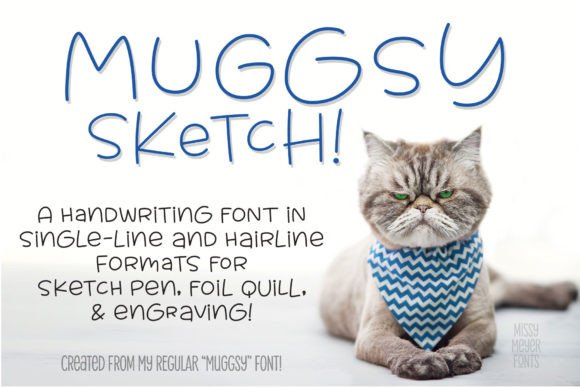
What is Muggsy Sketch single Line? It’s the conversion of the quirky, playful Muggsy handwritten font into a streamlined single-line format. This means each character is drawn with a continuous, unbroken line of consistent weight, similar to a hairline font. The result retains all the original’s charming irregularity—the uneven baselines, the whimsical letterforms, the hand-drawn feel—but presents it with a cleaner, more digitally-adaptable structure. Its personality is friendly, slightly offbeat, and inherently creative. It doesn’t shout; it sketches.
This makes it a powerful asset in a web designer’s toolkit. In a digital landscape saturated with ultra-clean sans-serif fonts and geometric headings, Muggsy Sketch single Line offers a way to inject warmth and approachability without sacrificing modern clarity. It bridges the gap between expressive handwriting and functional web typography.
Applying Muggsy Sketch single Line in Digital Spaces
Where does this font excel in practical layouts? Its strength lies in display and decorative roles, where personality is paramount but readability must be maintained.
Consider a creative portfolio website. Using Muggsy Sketch single Line for the main hero title immediately frames the designer or artist as innovative and personal. It can then be applied to section headings for “Projects” or “About Me,” creating a cohesive and distinct visual identity across the site. For a boutique online store selling handmade goods or unique apparel, this font is perfect for category banners, special offer call-outs, and the branding text on product detail pages. It communicates craft and individuality.
In conversion-focused layouts, like a landing page for a creative coaching service or a course sales page, Muggsy Sketch single Line can be strategically used to soften and humanize key areas. The main value proposition headline, when rendered in this font, feels more like a personal invitation than a corporate slogan. It builds an immediate sense of connection, which is crucial for trust and engagement.
Optimizing for Usability and Readability
Any decorative display font demands careful implementation for digital readability. Muggsy Sketch single Line, with its single-weight stroke, offers advantages here. Its consistency helps maintain clarity even at smaller sizes compared to more variable handwriting scripts.
For responsive web design, use Muggsy Sketch single Line primarily for larger text elements on mobile screens. It can work beautifully for page titles or section headers at a sufficient size. Avoid using it for body copy or very small button labels; the unique letterforms can become challenging to parse at tiny scales. On dark backgrounds or image overlays, ensure high contrast—a pure white or a bright accent color works well to keep the delicate line visible.
The font’s irregular baseline contributes to its charm, but for blocks of text like subheadings, consider setting a slightly larger line-height in your CSS. This gives the dancing letters room to breathe and prevents visual crowding, improving scanning behavior for the user.
Building a Cohesive Typographic System
A single font rarely builds a whole website. Pairing Muggsy Sketch single Line with a simple, highly readable sans-serif font for all body copy, paragraphs, and UI elements is the most effective strategy. This creates a clear visual hierarchy: the playful, personality-driven display font captures attention and sets the mood, while the neutral, functional sans-serif ensures effortless reading of all content. This pairing supports both brand impression and user practicality.
For a more editorial or sophisticated digital identity, pairing Muggsy Sketch single Line with a complementary serif font for longer introductions or block quotes can also work. The key is to let Muggsy Sketch single Line be the accent—the voice—while the supporting fonts handle the heavy lifting of content delivery.
Technical and Licensing Considerations for Web Use
Before integrating any font into a live website, check its technical specs. As a font from the Script Amp category, Muggsy Sketch single Line should be evaluated for its webfont availability. Can it be loaded via a standard @font-face rule with common formats like WOFF2? Does it include any stylistic alternates or ligatures that can be accessed via CSS for extra customization?
Most critically, verify the commercial font licensing. For use on websites, client projects, online stores, landing pages, or within digital templates and brand assets you create for sale, you must ensure your license permits such digital and commercial application. A desktop-only license is insufficient. Always acquire the proper webfont or commercial digital license to cover your specific use case—this protects you, your client, and the integrity of the project.
Crafting a Distinct Online Identity
Ultimately, Muggsy Sketch single Line is more than just a typeface; it’s a design asset for building a specific kind of online brand. It supports a brand tone that is human, creative, and a bit unconventional. When users encounter this font on a hero section, a blog graphic, or a digital ad, they don’t just read the words; they feel the intent. It transforms a standard layout into a branded web experience.
In a field where differentiation is key, a font like Muggsy Sketch single Line provides a subtle yet powerful tool. It allows web designers and digital creators to forge consistent online identities that resonate on an emotional level while maintaining the functional rigor required for effective websites. It sketches the personality of your brand directly into the code.